
Movement and access
Displacement, population movement, humanitarian access, border crossings, fragmented authority, administrative restrictions and deconfliction.
Independent open-source analysis of conflict, displacement, access, infrastructure and logistics affecting humanitarian operating conditions across the Red Sea, Horn of Africa and selected adjacent regions.
Optarus examines how conflict and instability affect the movement of people, humanitarian access, logistics networks, reception capacity and essential infrastructure. The focus is on decision-relevant operating conditions rather than humanitarian events in isolation.
Humanitarian need does not automatically translate into humanitarian access. Optarus examines the operating environment between available assistance and the population it is intended to reach.
Displacement, population movement, humanitarian access, border crossings, fragmented authority, administrative restrictions and deconfliction.
Ports, airports, roads, transport, warehousing, cold-chain capacity, communications resilience and supply dependencies.
Accommodation pressure and the resilience of food, fuel, water, medical and reception systems.
Conflict effects on civilian infrastructure, security control, mine and explosive-remnant contamination, and access-related exposure.
Local partner and implementing capacity, procurement and payment friction, and factors affecting the continuity of assistance.
Observable signs of improving or worsening access, logistics capacity, infrastructure resilience and humanitarian operating conditions.
The structure follows the question and available evidence rather than forcing every publication into identical headings.
Coverage reflects current source access, analytical relevance and collection capacity and may evolve as the Humanitarian Insights strand develops.
Humanitarian Insights may be useful to humanitarian organisations and NGOs; donors and implementing partners; logistics, freight, transport and warehousing providers; security and risk functions; insurers and assistance providers; political and regional analysts; and organisations supporting medical, communications, infrastructure or supply-chain activity.
Independent analysis—not an aid or response service.
Optarus does not replace organisation-specific security, legal, medical, programme or logistics planning. It does not tell organisations whether they should deploy, enter an area or conduct a specific operation.
Humanitarian Insights are published on a trigger-led basis when sufficient evidence exists to support a substantive, decision-relevant assessment. The initial expected cadence is approximately one substantive Humanitarian Insight every two to four weeks, depending on developments and evidential maturity.
Potential triggers include material displacement or access change, major logistics or infrastructure disruption, reception-capacity pressure, significant health or WASH deterioration, programme or funding constraints, cross-border displacement, or several weaker indicators converging into a meaningful change.
Humanitarian Insights may also highlight a relevant charitable appeal, allowing readers who wish to do so to support organisations responding directly to the human consequences discussed in the analysis.
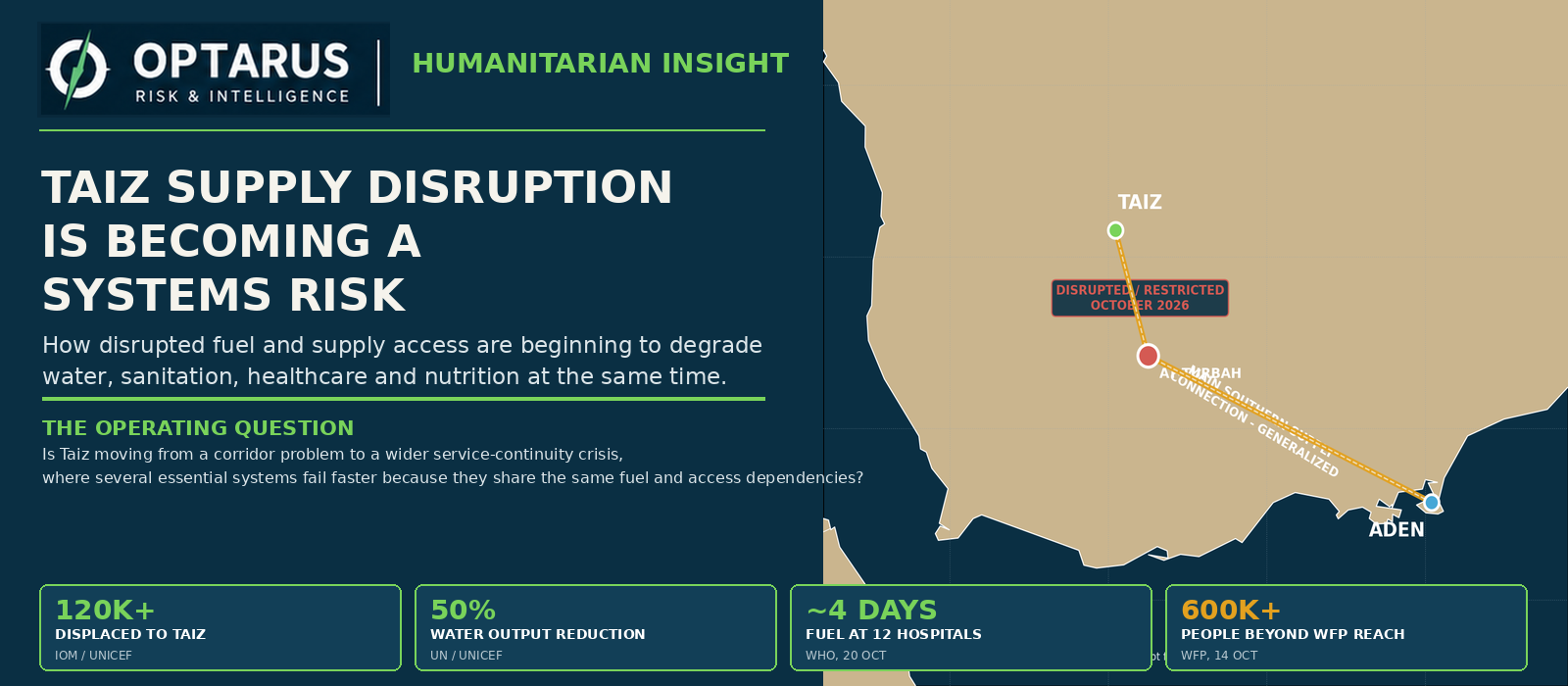
Disrupted fuel and supply access are no longer only a transport problem
This Humanitarian Insight examines how disruption to the Taiz–Aden supply corridor is beginning to affect several essential services at the same time. Fuel and supply constraints are now affecting water pumping, waste collection, hospitals, food support and nutrition programmes, increasing the risk that several already-fragile systems deteriorate together.
Complimentary public assessment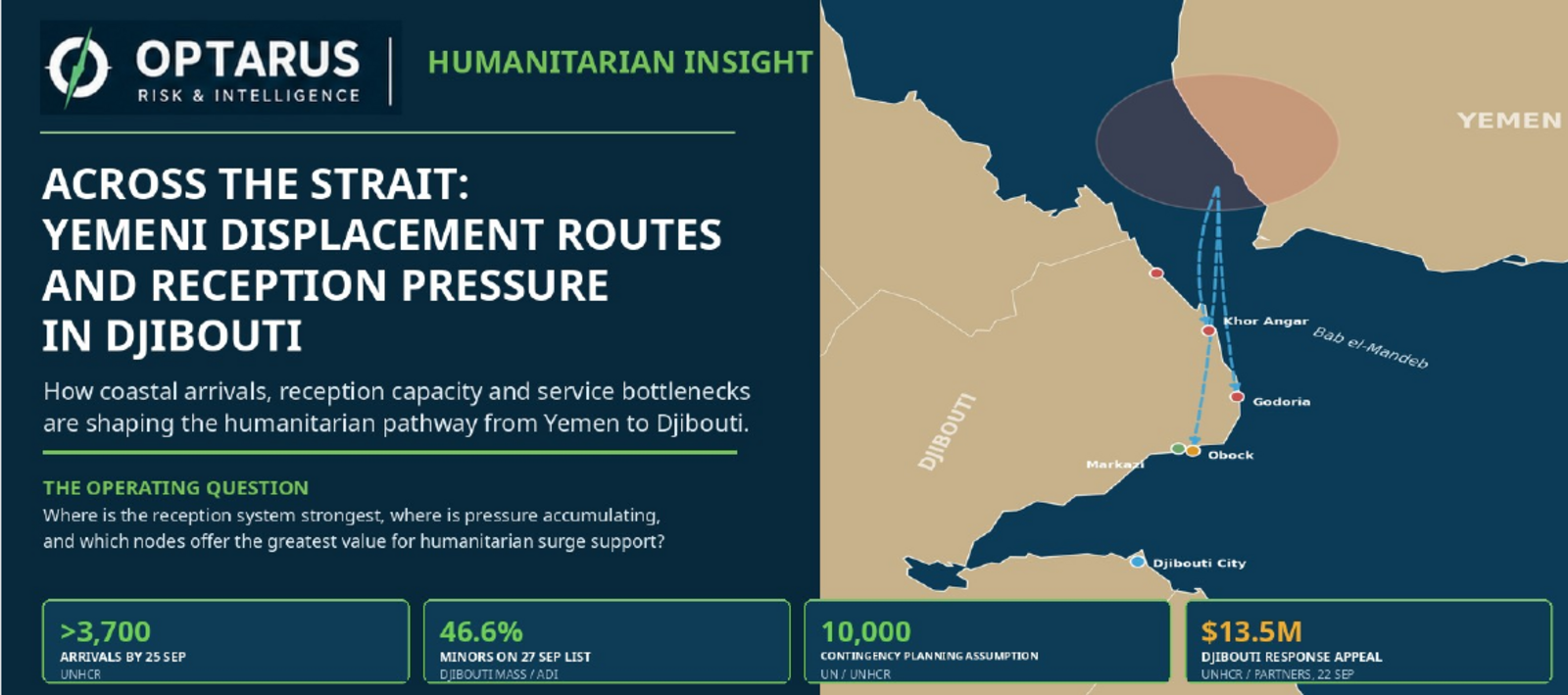
How coastal arrivals, reception capacity and service bottlenecks are shaping the humanitarian pathway from Yemen to Djibouti
This Humanitarian Insight maps the displacement and reception system linking Yemen’s western coast with northern Djibouti. It examines coastal arrival points, the Obock–Markazi reception chain, host-community pressure, health referral, transport, shelter, WASH and service capacity to identify where humanitarian pressure is accumulating and where additional support may have the greatest effect.
Complimentary public assessment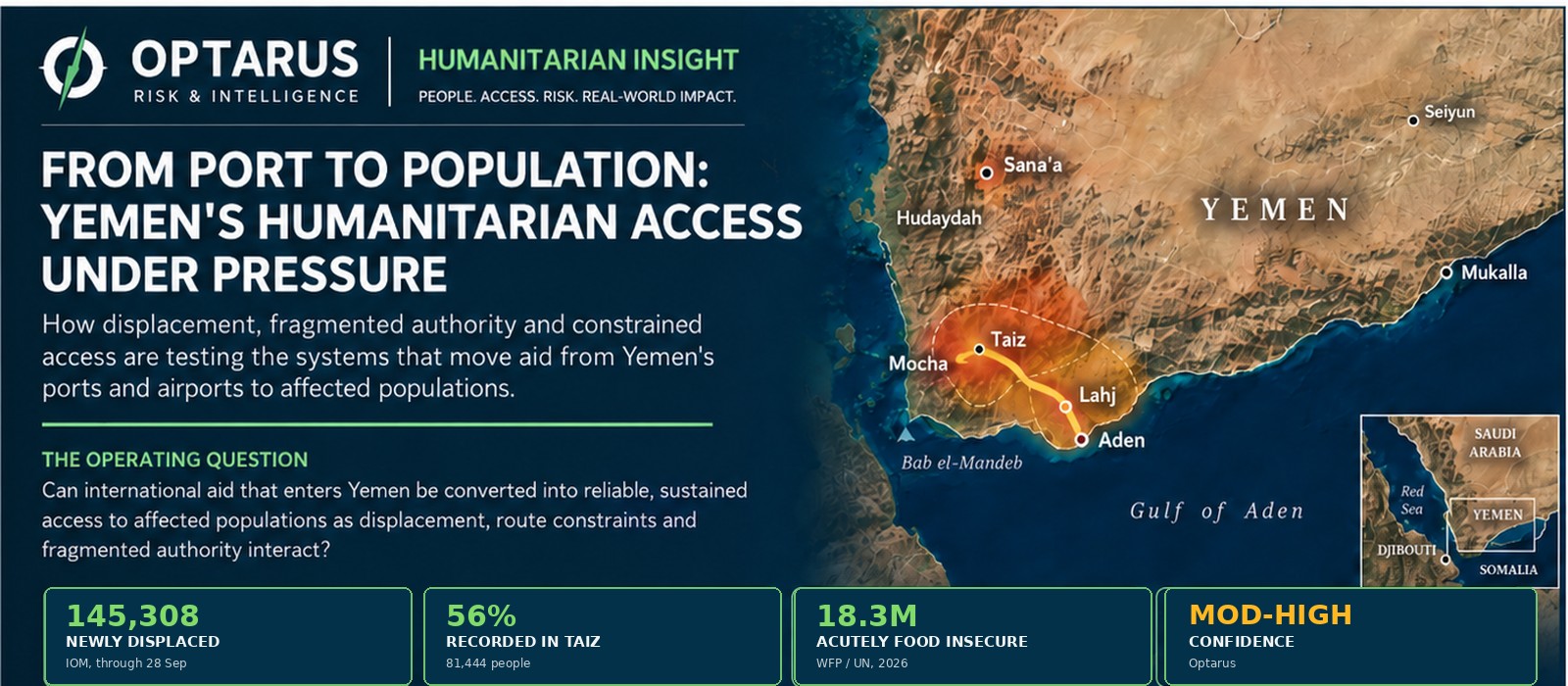
How displacement, fragmented authority, difficult terrain and constrained access are affecting the systems that move humanitarian assistance from Yemen’s ports and airports to affected populations.
Free public assessment
How Yemen Displacement Is Testing Djibouti’s Northern Support System
Yemen-driven displacement is placing observable pressure on northern Djibouti’s reception and support system. The assessment examines possible interaction with transport, fuel, medical, accommodation, security-support and Ethiopia–Djibouti corridor capacity.
Free to readOptarus applies a do-no-harm approach to Humanitarian Insights. Public reporting avoids publishing sensitive live movements, vulnerable-person data, unpublished shelter locations or operational details that could increase risk to humanitarian personnel or affected populations.
Humanitarian Insights remain freely accessible. They are independent open-source assessments of operating conditions and do not imply affiliation with a humanitarian organisation, the United Nations or any listed relief agency.