
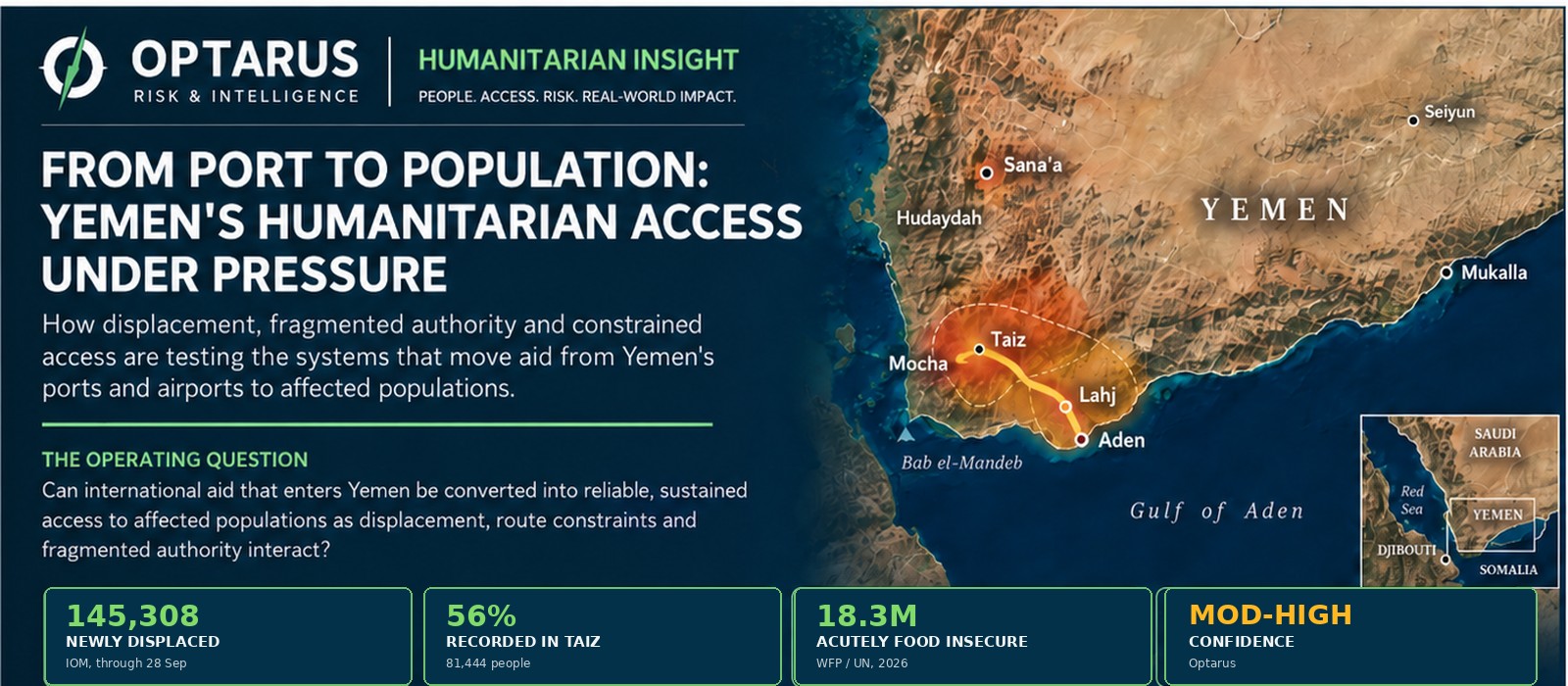
Renewed fighting and displacement in Yemen are creating an increasingly complex humanitarian operating environment. This assessment examines the delivery chain from international entry points to affected populations, including ports, aviation, road access, fragmented anti-Houthi authority, deconfliction, warehousing, explosive hazards, health capacity and reception pressure.
Assessment focus
The report examines the systems required to convert available humanitarian assistance into delivery to affected populations. It considers international entry points, onward movement, permissions and deconfliction, storage and transport capacity, difficult terrain, explosive hazards, health capacity and pressure within receiving areas.
Continuing operating-picture coverage
This Humanitarian Insight is published free of charge. Material subsequent changes may be addressed through FA-72, Intelligence Alerts, Assessment Updates or a later Insight where appropriate.
Methodology and safeguards
This publication distinguishes verified information, attributed reporting, analytical judgement, uncertainty and collection gaps. It applies a do-no-harm approach and does not publish sensitive live movements, vulnerable-person data, unpublished shelter locations or operational information where disclosure could materially increase risk.