
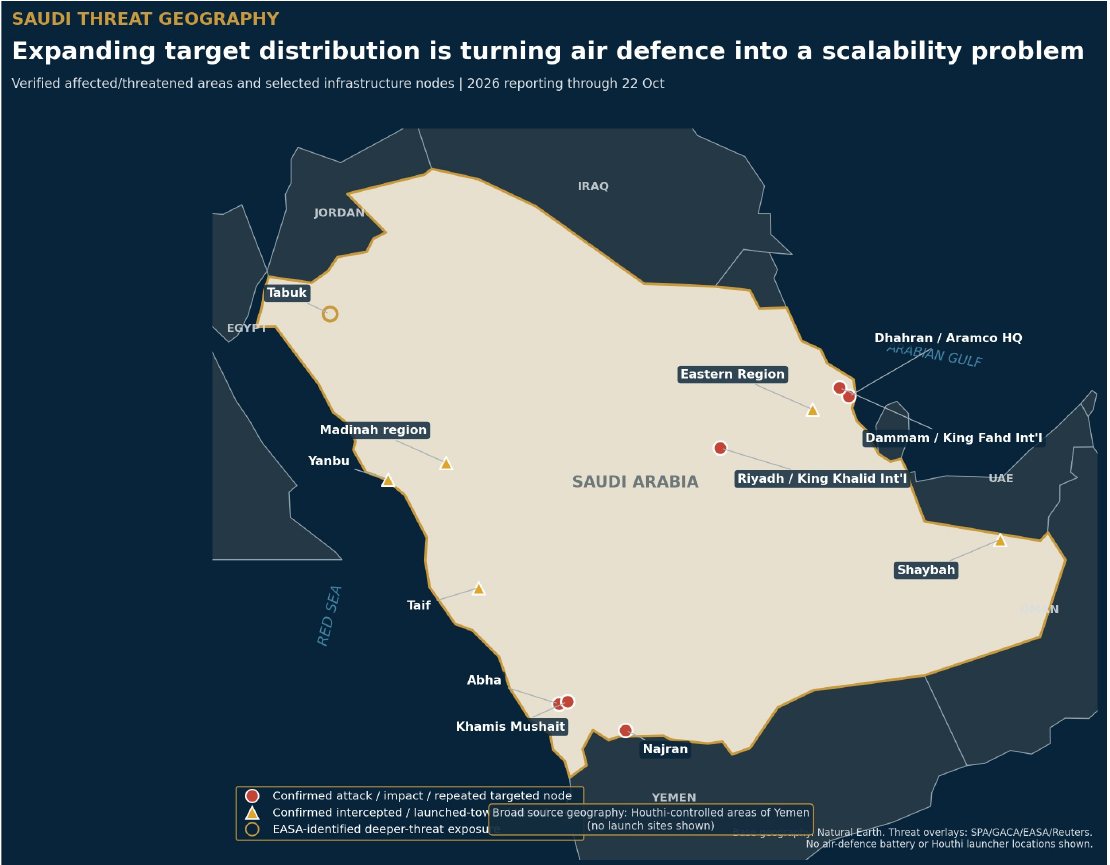
Saudi Arabia is successfully intercepting significant numbers of Houthi missiles and drones, but the expanding geographic distribution of attacks is creating a different problem: how to protect an increasingly dispersed set of aviation, energy, urban, military and logistics assets with finite defensive systems and interceptor inventories.
This Regional Insight examines whether the campaign is evolving from a question of interception effectiveness into one of defensive scalability — and why greater geographic dispersion may force increasing prioritisation, deeper allied integration, lower-cost counter-UAS options and stronger emphasis on detecting and disrupting the launch cycle.
The Houthis do not need to overwhelm every Saudi air-defence battery to create strategic effect. A geographically distributed campaign can impose cost and operational burden by forcing Saudi Arabia to defend more locations, disperse finite defensive resources and accept residual exposure elsewhere — even where individual incoming weapons are successfully intercepted.
Publication scope. The report distinguishes confirmed deployed allied capability from announced support and prospective capability. It assesses counterforce as one part of a wider defensive approach, not as a guaranteed or exclusive solution.