
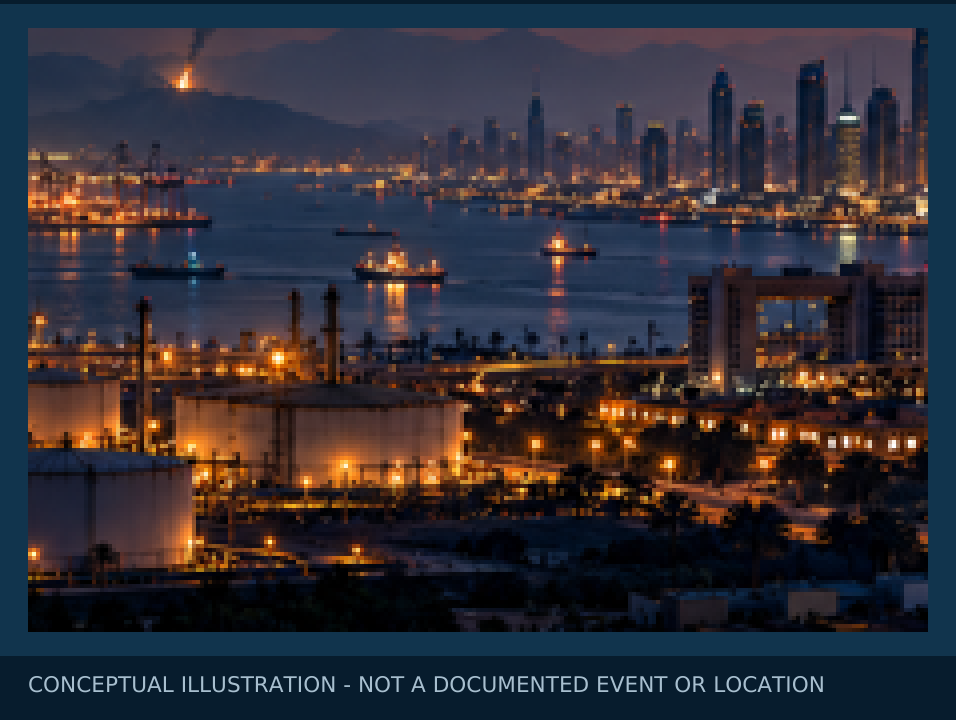
A renewed US strike on Iran remains a credible contingency, but its timing is not established. The decisive risk for regional commerce is whether another military exchange produces sustained disruption across energy, shipping, aviation and digital infrastructure faster than operators can adapt.
Iran and aligned armed groups can impose disproportionate economic costs without achieving conventional military superiority. Diplomacy and defensive adaptation remain material counterweights to escalation.
The wider commercial risk lies in sustained, geographically distributed disruption across energy, shipping, aviation, infrastructure and regional business operations — not in assuming that a fresh strike has already been authorised or timed.
What the current evidence establishes
Maritime authorities continue to record attacks and commercial casualties across the region. The report treats official maritime reporting, government releases and energy-market data as the evidential backbone, while retaining the distinct coverage and verification criteria used by different bodies.
Energy and shipping flows have partly recovered, but stronger headline movement does not demonstrate restored operational resilience. Expensive adaptation, trans-shipment, reduced effective vessel capacity and persistent exposure can keep cargo moving while commercial conditions remain materially abnormal.
Four escalation pathways
Leading working case — calibrated coercion
A continued stand-off, punctuated by maritime and proxy attacks and military signalling, currently best explains the combination of economic pressure, continuing lower-intensity hostilities and active diplomacy.
Material risk — limited strikes and bounded retaliation
A limited US strike followed by calibrated Iranian retaliation remains a credible alternative. Planning and deployed capability create options, but neither public signalling nor force posture establishes executive authorisation or a reliable attack date.
Highest consequence — wider infrastructure confrontation
A broader campaign against energy, shipping, aviation or digital infrastructure would impose effects disproportionate to the physical footprint of individual strikes. This pathway is lower confidence, but its potential commercial consequences warrant attention.
Countervailing pathway — negotiated pause
Diplomatic engagement and a shared interest in reducing oil, shipping and regional economic costs remain meaningful counter-evidence to an inevitable-escalation narrative.
How disruption reaches business operations
The opening military exchange would not determine the commercial outcome on its own. The more important sequence runs from retaliation intensity and the actions of aligned groups into the availability of ships, aircraft, ports, export routes and digital services — and then into insurance, financing, supply-chain and investment decisions.
- Shipping and insurance: casualty risk, port restrictions, crew exposure, longer voyages, higher war-risk costs and reduced effective vessel capacity.
- Energy and industrial systems: pressure on export redundancy, processing nodes, refined fuels, petrochemicals and downstream logistics.
- Aviation and personnel: disruption to airspace, airports, rotations, maintenance access and duty-of-care arrangements.
- Digital and financial continuity: exposure of subsea cables, cloud services and payment or communications infrastructure, while reported threat planning remains distinct from confirmed execution.
Bottom line
Further US strikes would matter commercially chiefly through the response they generate and the accumulated fragility of a regional system already operating at elevated cost. Iran and aligned armed groups do not need a decisive conventional victory to impose a measurable regional and global economic penalty.
Equally, partial export recovery, defensive adaptation and active diplomacy argue against assuming an inevitable general war. The prudent judgement is sustained high commercial exposure, with conditional escalation scenarios and explicit evidence thresholds — not a countdown to an unverified attack date.