
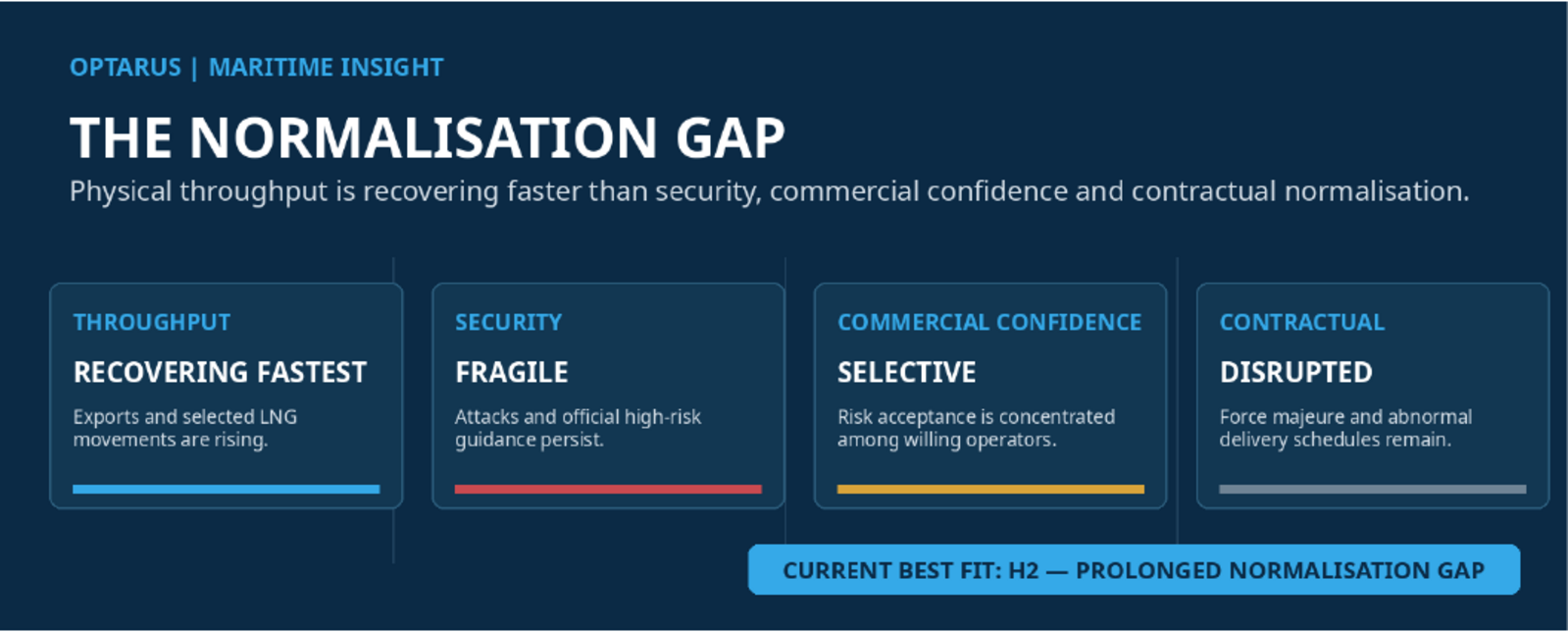
Gulf energy flows are recovering faster than the security, commercial and political conditions supporting them. This Maritime Insight examines the widening “Normalisation Gap” in the Strait of Hormuz and assesses three pathways for shipping: negotiated normalisation, prolonged partial recovery, and renewed coercion.
Physical throughput is recovering faster than security, commercial confidence and contractual normalisation.
Current assessment
Current evidence best fits prolonged partial recovery. Crude exports are recovering through ship-to-ship relays, shuttle tankers, alternative routes and other adaptations while maritime attacks, abnormal insurance conditions, liquefied natural gas contractual disruption and regulatory constraints persist.
Three pathways for shipping
- Negotiated normalisation: an implemented political and maritime arrangement begins restoring reciprocal access, security confidence and more predictable commercial conditions.
- Prolonged partial recovery: physical throughput continues to improve through adaptation while the surrounding security, contractual and regulatory environment remains abnormal.
- Renewed coercion: attacks, disruption or political breakdown reverse parts of the operational recovery and intensify exposure.
Continuing operating-picture coverage
This Maritime Insight is published free of charge. Material subsequent changes may be addressed through FA-72, Intelligence Alerts, Assessment Updates or a later Maritime Insight where appropriate.
Methodology and safeguards
This is an open-source analytical assessment. The complete report records its source base, confidence, uncertainty, alternative pathways, sanctions and regulatory limitations, and the indicators that would materially change the judgement. It provides decision support rather than legal, insurance, sanctions-compliance, navigational or operational advice.