
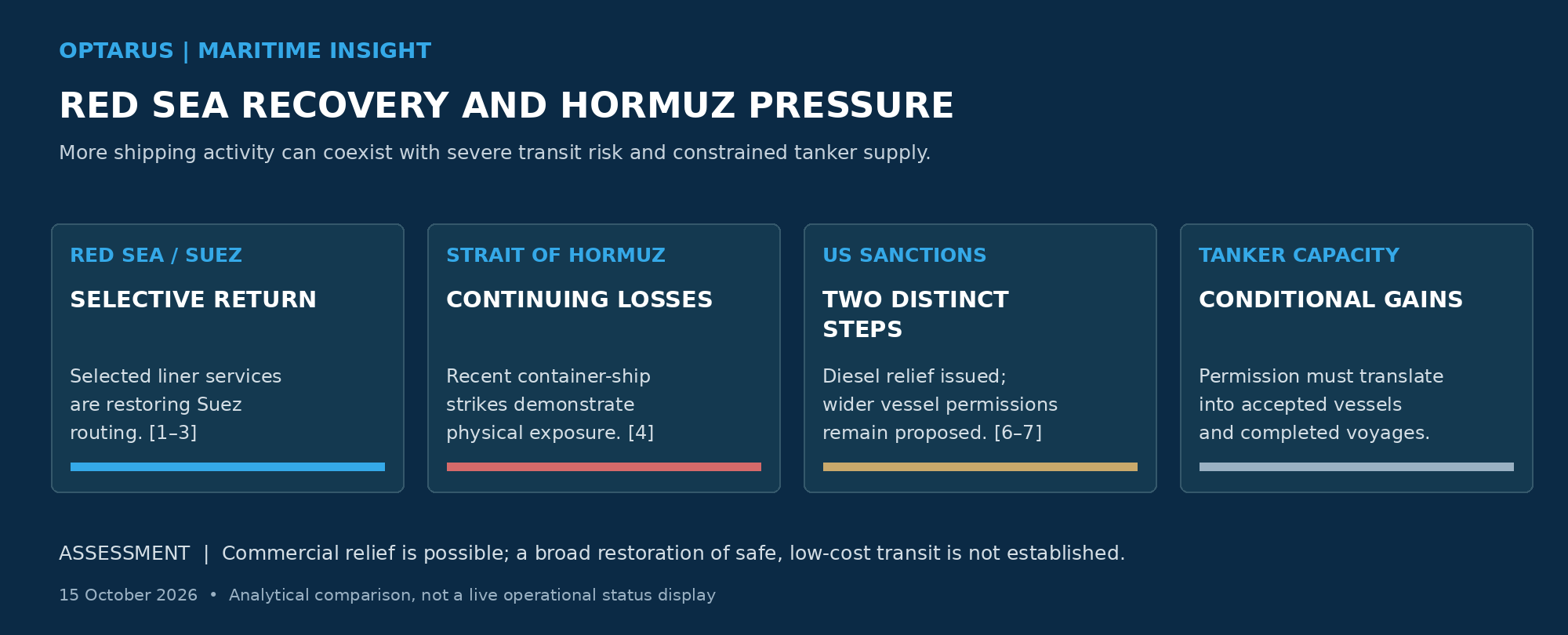
Selected container services are returning to Suez while recent vessel losses in the Strait of Hormuz demonstrate that cargo movement and vessel safety remain separate questions. Prospective US permissions for sanctioned tankers could ease some capacity pressure, but only where vessels prove legally, technically and commercially acceptable.
Commercial recovery is becoming more visible, but it remains selective, segmented and reversible. Current evidence is more consistent with commercial adaptation to persistent security risk than with full security normalisation.
Key judgement
Shipping is adapting to persistent disruption at different speeds. Selected container services are returning to Suez, while recent losses in the Strait of Hormuz show that cargo movement and vessel safety remain separate questions. US sanctions policy could affect both available fuel and the pool of legally usable tankers, but those are different mechanisms. A temporary Russian-diesel authorisation is in force; wider permissions for previously sanctioned vessels remain a reported proposal. Even if granted, permissions would have to produce vessels that charterers, insurers, terminals and crews accept before materially easing freight pressure. Our central assessment is selective commercial improvement with continuing physical and commercial constraints. The strongest evidence of a broader recovery would be repeated completed voyages, a wider pool of participating owners and sustained reductions in delivered cost, rather than policy announcements or cargo volumes alone.
Suez container capacity / 2023 [1]HORMUZ
Recent vessel losses [4]SELECTIVE
Commercial recoveryMODERATE
Overall analytical confidence
EXECUTIVE ASSESSMENT
What the evidence now supports
The commercially important development is the combination of renewed route use, continuing maritime casualties and attempts to relieve shipping and fuel constraints. These developments can coexist. They do not support a single conclusion that either the whole region has reopened or commercial recovery is impossible.
| Development | Evidence and boundary | Decision relevance |
|---|---|---|
| Suez container recovery | BIMCO reports weekly capacity of 753,000 TEU in the first two weeks of October against 1.457 million in the equivalent 2023 period: 51.7%. Capacity is not vessel count or schedule reliability. [1] | A growing share of liner capacity is accepting the corridor; the figure does not describe tanker or LNG conditions. |
| Carrier commitments | Maersk announced four additional Gemini trans-Suez services. Hapag-Lloyd retains service-specific reviews and naval protection. [2–3] | Shorter rotations could improve asset use, but the return remains conditional and reversible. |
| Hormuz exposure | Singapore’s MPA confirmed projectile strikes on GFS PRIDE and GFS GISELLE on 13–14 October. PRIDE sank; GISELLE reached safe anchorage. Crews were evacuated or reported safe. [4] | Risk is demonstrated beyond tankers; restored cargo flow cannot be treated as assurance of safe transit. |
| Fuel and vessel permissions | OFAC issued diesel GL 135 on 9 October. Separately, Reuters reports discussion of permissions for sanctioned vessels carrying lawful oil. [6–7] | Distinguish an issued cargo-related authorisation from a prospective expansion of usable vessel supply. |
| Gulf supply recovery | The IEA estimates September Gulf crude exports at 13.9 million barrels/day, over 75% of pre-war levels, but warns renewed attacks threaten recovery. [8] | Recovered output still has to be moved, insured and delivered; crude recovery is not uniform recovery across fuels. |
Evidence quality: official licences and flag-state casualty reporting establish what has been authorised or reported by the competent authority. Carrier notices establish announced commercial decisions, not completion of every scheduled voyage. Industry capacity and flow estimates are measurements with different denominators. The wider tanker proposal is attributed reporting; no additional available-vessel count is established here.
PUBLICATION THRESHOLD
The new information changes the commercial question: can selective Suez recovery and US permissions ease effective shipping constraints while Hormuz remains dangerous? This merits an assessment of consequences, rather than a news summary or a claim that regional conditions have returned to normal.
CURRENT THREAT PROFILE
Red Sea and Hormuz require separate judgements
JMIC’s 11 October advisory assessed Hormuz as SEVERE and Bab el-Mandeb / southern Red Sea as SUBSTANTIAL, while northern Red Sea / Suez was MODERATE. These are dated official assessments, not a fresh Optarus regrading. The same advisory describes navigation interference and routing pressure. Its facilitated Hormuz transit figure covers a subset of traffic and must not be divided by an all-vessel historical baseline to claim a recovery percentage. [5]
The later Singapore casualty statement supplies direct evidence of continuing container-shipping exposure in Hormuz. It identifies unknown projectiles; it does not establish the attacker or weapon. We do not use unverified attribution or infer that every vessel faces identical targeting risk. [4]
Reuters reported renewed Houthi threats against Saudi airports and oil facilities on 14 October following the Aramco headquarters strike. This preserves a regional escalation channel; it is not evidence that a specific restored liner service will be attacked or that all Red Sea transits have stopped. [11]
Insurance posture
The Joint War Committee’s public page identifies JWLA-035 as its current listed-areas reference and states that rating is individually negotiated. A listed area is not a quoted premium. This assessment does not assert a new market-wide war-risk rate or a confirmed easing of cover. Hull war, P&I, cargo and contractual exposures must be distinguished. [12]
MARITIME OPERATING PICTURE
Why Suez can recover while Gulf shipping remains constrained
For container networks, a shorter Suez rotation can release vessel-days and reduce fuel use relative to Cape routing. If schedules remain reliable, competitors face pressure to recover similar efficiencies. The opposite mechanism remains available: an incident, reduced protection or crew concerns can erase the saving and prompt renewed diversion. This is a commercial interpretation of the carrier decisions, not proof of a permanent return.
For Gulf energy movements, the controlling issue is effective transport capacity. Shuttle and transfer arrangements can preserve exports while using more vessel time, cargo handovers and services. Nominal fleet size therefore overstates the capacity that can complete the required voyage on acceptable terms.
BIMCO’s 8 October public analysis gives a useful wider signal: LR2 clean-product cargo volumes fell 28% year-on-year over the first nine months, while tonne-mile demand rose 2%. Less cargo can still require more transport work. That is consistent with pressure on shipping efficiency; the figures alone do not isolate the contribution of any one route or sanction. [9]
There is also no universal bypass. Moving Gulf crude west by pipeline can avoid Hormuz for that part of the movement, but an Asia-bound sea leg from the Red Sea may still depend on Bab el-Mandeb. Container routing, crude export options and specialised gas shipping should not be treated as interchangeable capacity.
COMMERCIAL EXPOSURE
What US sanctions easing actually changes
Two separate policy developments need to be kept distinct. OFAC General License 135 authorises transactions under the specified Russia-related regulations connected with Russian-origin diesel sale, delivery, offloading and importation, including into the United States, until 12:01 a.m. EDT on 7 April 2027, subject to its exception. It is a defined authorisation, not repeal of the wider sanctions system. Its operative text controls any particular transaction. [6]
Separately, Reuters reports that Washington is considering permissions for previously sanctioned tankers to carry non-sanctioned oil, with companies applying to Treasury. Its reporting cites industry scepticism about immediate fleet gains because many ships already trade and face condition or service restrictions. This is not a blanket implemented release of cargo ships. [7]
How additional tankers could affect the market
Our assessment is that the first benefit, if permissions are implemented and accepted commercially, would be more choice for particular cargoes and voyages. An additional ship suited to a short Gulf shuttle could release another acceptable vessel for longer-haul employment. That would increase flexibility before it necessarily produces a broad freight decline. No credible count of the incremental accepted fleet has been established in this collection.
A vessel already carrying cargo does not become new global capacity merely because its legal trading options expand. Capacity gains depend on whether the change makes it usable for a previously constrained movement, reduces waiting or releases another vessel. Repositioning, inspection, repair and terminal acceptance could delay the effect. Crude tankers, clean-product carriers and LNG carriers are not substitutes simply because all transport energy.
| Capacity test | What would have to change |
|---|---|
| Legal usability | The actual permission covers the vessel, cargo, parties, services and voyage under the applicable jurisdictions. |
| Technical acceptance | Class, flag, maintenance and terminal requirements permit the intended employment. |
| Commercial participation | Charterer, insurer, bank, service providers and crew accept the specific voyage. |
| Additional transport work | The ship completes extra useful movements rather than merely shifting existing activity between trades. |
| Freight transmission | More prompt accepted tonnage competes for cargo; savings survive security costs, delay and transfer requirements. |
US relief does not itself remove UK or EU restrictions. Britain added 12 shadow-fleet tankers on 8 October, while the Council’s July package also targeted vessels and associated activity. A vessel permitted for a US transaction may still face another jurisdiction’s restrictions or a commercial refusal. [10,13]
COMMERCIAL EXPOSURE
Who could benefit and where costs could persist
For charterers and refiners, greater accepted supply could improve bargaining power, reduce waiting and make some cargo sources commercially viable again. But additional available diesel and additional transport capacity are different things. An authorisation cannot repair a refinery, restore a damaged berth or secure a transit.
The IEA’s October assessment says Middle East refined-product and LPG exports remain below half their pre-war levels and identifies damaged Russian refining capacity as a limit on the benefit of diesel export easing. This is why fuel-price relief need not follow the legal change quickly or proportionately. [8]
For tanker owners, incremental competition could reduce exceptional returns on particular routes before rates fall across the sector. Cargo demand, distances and operational delays may absorb the new availability. For cargo buyers, delivered cost matters more than headline freight alone: war-risk costs, transfers, waiting and financing can offset a cheaper fixture.
For insurers and service providers, a changing legal permission does not remove casualty accumulation or technical exposure. Greater reliance on older ships or concentrated transfer operations could expand pollution, collision and claims exposure. That is a conditional risk mechanism, not an allegation about any named vessel.
The market evidence does not show uniform easing
Baltic Exchange Week 41 assessments, dated 9 October, put TD3C Middle East Gulf–China at $1,412,594/day round-trip time-charter-equivalent earnings and TD34 Gulf of Oman–China at $912,660/day. Their $499,934/day difference is not a pure Hormuz premium: route assumptions and wider market conditions differ. These are earnings assessments, not simple daily hire invoices or live 15 October quotes. [14]
The relevant test is whether later observations show sustained improvement across accepted-vessel availability, completed cargo delivery and comparable route costs. An initial fall on a policy headline could reverse if permissions are narrow, demand absorbs the capacity or another attack reduces owner participation.
INDICATORS & WARNINGS
The next 72 hours and the following two to eight weeks
| Indicator | Effect on the assessment |
|---|---|
| Published vessel permissions and scope | Moves the wider tanker proposal from reported discussion to an implementable measure; does not prove take-up. |
| Named accepted vessels and completed voyages | Provides evidence of actual capacity, especially where an additional shuttle releases another ship. |
| Comparable freight, cover and waiting-time data | Sustained multi-route improvement supports broader relief; isolated headline moves do not. |
| Persistence of restored Suez services | Repeated voyages and continued participation after an adverse event support durable commercial recovery. |
| New casualties, service withdrawals or infrastructure damage | Could outweigh permissions, reduce effective tonnage and reverse route or supply gains. |
OUTLOOK
Three plausible commercial outcomes
| Pathway | Mechanism and evidence that would distinguish it |
|---|---|
| Selective relief — central case | Permissions or cargo relief improve specific trades, but technical acceptance, other jurisdictions and physical risk limit broad savings. Suez gains remain service-specific. Look for a small accepted fleet and uneven route pricing. |
| Broader improvement | Implemented permissions, wider commercial acceptance and fewer disruptions combine to increase completed voyages. Comparable freight and delivered costs fall for several weeks while more owners participate. |
| Recovery reverses | Further attacks, infrastructure loss or withdrawal of protection reduce willingness to trade faster than any legal relief expands it. Cape diversions, waiting and delivered costs rise again. |
We assess selective relief as the most plausible near-term outcome, with MODERATE confidence. Confidence is HIGH in the distinction between the issued diesel licence and the still-reported wider vessel proposal, and in the cited official casualty statement. Confidence is LOW in the size and timing of incremental tanker capacity: no accepted-vessel roster, completed-voyage evidence or reliable relief estimate is available in the collected material.
The main competing explanation is that legal flexibility could unlock more useful capacity than current industry scepticism suggests. That would strengthen if major service providers and charterers accepted vessels promptly and several comparable routes showed sustained easing. The opposite risk is that physical disruption dominates and additional permissions have little practical effect.
BOTTOM LINE
The Red Sea and Hormuz are showing different forms of adaptation, not a shared return to dependable low-cost shipping. US relief could improve fuel availability and selected tanker employment, but only useful completed transport creates a durable commercial gain. Watch the ships and cargoes that actually move, the owners and insurers willing to participate, and delivered costs—not the announcement alone.
METHODOLOGY & LEGAL-RISK REVIEW
Evidence boundaries and decision use
Collection cut-off: 15 October 2026, 08:10 BST. Primary sources take precedence for licences, official casualty reporting, carrier decisions and industry measurements. Reuters is used as attributed reporting for the prospective vessel policy and Saudi escalation. The 11 October JMIC advisory is a dated baseline supplemented by the later flag-state statement; it is not represented as a new 15 October advisory.
The analysis separates confirmed authorisations, reported proposals, observed commercial behaviour and Optarus inference. Suez container capacity, Gulf oil exports, facilitated transit counts and tanker earnings describe different populations and cannot be combined into a single recovery score. Current vessel availability, private insurance quotations and charterer acceptance remain collection gaps.
This is strategic decision support, not legal, sanctions-compliance, financial, insurance, security or navigational advice. Current licences, designation lists, policy terms and contracts control individual decisions. No vessel is described as safe or legally usable merely because a policy is discussed. AI assisted collection and drafting; final source reconciliation, analytical judgement and release remain with Optarus.
Acronyms and terms
TEU — twenty-foot equivalent unit, a container-capacity measure. LR2 — long-range product tanker class. LNG — liquefied natural gas. LPG — liquefied petroleum gas. TCE — time-charter-equivalent earnings, a voyage earnings calculation. P&I — protection and indemnity liability insurance. OFAC — US Office of Foreign Assets Control. JMIC — Joint Maritime Information Center. Effective capacity — vessels able and willing to complete the required transport under acceptable legal, technical and commercial conditions.
SOURCE APPENDIX
Selected source base
- [1] BIMCO · 14 October 2026
Suez Canal container ship transits exceed 50% of pre-disruption levels
Public extract; Clarksons Research capacity comparison.
- [2] Maersk · 14 September 2026
Structural changes to AE5, AE11, AE12 and ME2 Gemini services
Carrier announcement; announced routing is not proof of every completed sailing.
- [3] Hapag-Lloyd · 28 September 2026; current page checked 15 October
SE1 service update
Service-specific approach, sailing schedule and security conditions.
- [4] Maritime and Port Authority of Singapore · 14 October 2026
Two Singapore-Registered Vessels Struck in Strait of Hormuz
Flag-state casualty statement; projectiles unidentified.
- [5] JMIC / UKMTO · 11 October 2026
Update 104 to JMIC Advisory Note
Dated official regional threat baseline; transit datasets have different scope.
- [6] US Treasury / OFAC · 9 October 2026
General License 135
Operative diesel authorisation and exception; expiry 7 April 2027.
SOURCE APPENDIX
Selected source base continued
- [7] Reuters · 15 October 2026
US considers easing sanctions on shadow fleet vessels to cut freight rates
Attributed proposal and industry assessment; not evidence of a blanket vessel licence.
- [8] International Energy Agency · 14 October 2026
Oil Market Report October 2026
Public highlights and analysis; September flow estimates are not live daily traffic.
- [9] BIMCO · 8 October 2026
LR2 demand grows despite 28% fall in clean product volumes
Public extract; cargo volume and transport work differ.
- [10] UK FCDO · 8 October 2026
New UK sanctions hit the money, oil and supply chains fuelling Russia’s war
Official UK measures; relevant jurisdictions remain separate.
- [11] Reuters · 14 October 2026
Yemen’s Houthis vow more attacks on Saudi airports and oil facilities
Attributed escalation reporting; no inference of a specific future vessel target.
- [12] Lloyd’s Market Association · Current page checked 15 October 2026
Joint War Committee
Current listed-area reference and individually negotiated rating; no premium quotation.
- [13] Council of the European Union · 23 July 2026
21st package of sanctions
Official EU measures; not a claim that US permissions amend EU rules.
- [14] Baltic Exchange · 9 October 2026
Tanker report Week 41
Dated round-trip TCE assessments; not daily hire invoices or a pure security premium.