
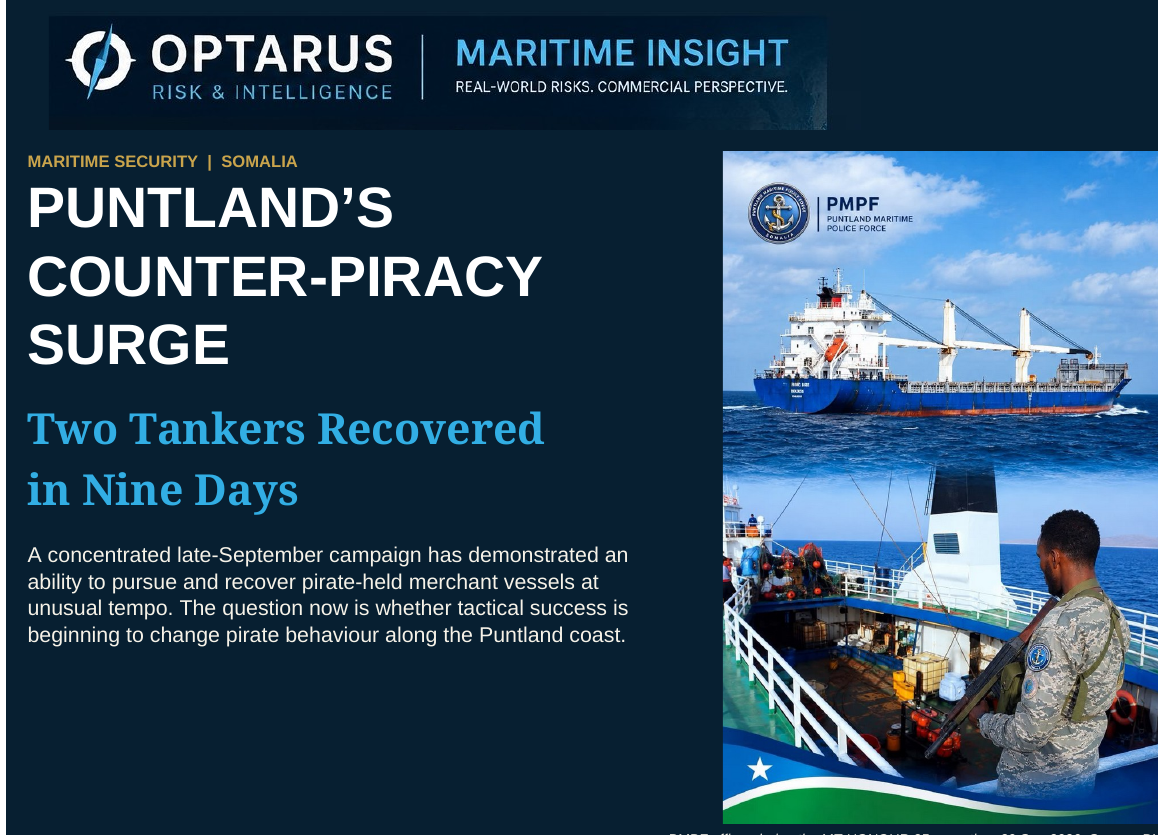
Puntland security forces have recovered two pirate-held merchant vessels in nine days, demonstrating increased tactical effectiveness and an unusually high operational tempo.
The evidence does not yet establish the strategic suppression of Somali piracy, but sustained pressure could begin to alter the viability of holding captured vessels close to the Puntland coast.
What the evidence supports
| Issue | Evidence position | Current judgement |
|---|---|---|
| SIBU 1 | Recovered | The 25 September recovery demonstrates successful pursuit, but the reported transfer and custody failure limits the claim of durable disruption. |
| MT HONOUR 25 | Recovered | PMPF recovery is established. The updated seven-dead/six-wounded casualty total remains attributable reporting; the circumstances have not been independently reconstructed. |
| Suspected pirate detainees | Disputed totals | Initial detailed reporting indicated at least 16; later PMPF-linked reporting gave 21. Neither figure is used as a definitive total. |
| MV EUREKA | Not confirmed | Reported abandonment and crew safety were not formally confirmed by PMPF, EUNAVFOR or MSCIO at the reporting cut-off. EUREKA is not counted as a third recovery. |
| ASANA | Outstanding watch item | ASANA remains the principal outstanding vessel in the pirate-held cohort at the reporting cut-off. |
Operational significance
Two recoveries inside a concentrated campaign window show that Puntland maritime and ground elements can find, pursue and regain control of pirate-held vessels close to the Puntland coast. The significance lies in the concentration and tempo of successive operations rather than the emergence of an entirely new capability.
The legal and custodial finish remains a material weakness. Interdiction at sea does not itself establish durable disruption; secure detention, evidence continuity, investigation and prosecution determine whether tactical recovery produces longer-term effect.
Commercial-maritime implication
The immediate piracy threat remains. If pirate groups can no longer hold captured vessels for months close to Puntland’s coast while ransom negotiations proceed, their economics and operating model may begin to change. Plausible adaptations include relocation of holding areas, shorter ransom timelines, greater use of motherships or more coercive treatment of hostages—each creating a different risk profile for shipowners, charterers, crews and P&I interests.
Tactical effectiveness and operational tempo have increased. Strategic suppression of Somali piracy across the wider Gulf of Aden and western Indian Ocean is not established.
Confidence and indicators
- High confidence that Puntland forces have demonstrated increased tactical counter-piracy capability.
- High confidence that successive operations were conducted at unusually high tempo.
- Moderate confidence that sustained pressure could degrade pirates’ ability to hold vessels close to Puntland-controlled coastline.
- Not established: strategic suppression across the wider western Indian Ocean.
Indicators that would materially change the judgement include authoritative confirmation of EUREKA’s status, reconciled detention totals, demonstrably secure custody and prosecution, or verified displacement of pirate holding areas southward, farther offshore or into mothership operations.
Sources and editorial safeguards
The assessment draws on official PMPF and Puntland reporting, Reuters, local Somali reporting and the EUNAVFOR/MSCIO incident record. The publication distinguishes official claims from independently corroborated facts, retains contradictory totals and does not infer motive or external direction without evidence.
- Puntland Maritime Police Force official account
- Reuters — Puntland reports MT HONOUR 25 crew fatalities
- MSCIO / EUNAVFOR incident record — MT HONOUR 25
Methodology and safeguards
This is an open-source analytical assessment. Analyst-directed AI tools supported source retrieval, comparison, drafting and quality control. Analytical judgements, attribution decisions and publication thresholds were reviewed against the cited reporting before release. No AI-generated imagery or invented geography has been used.