
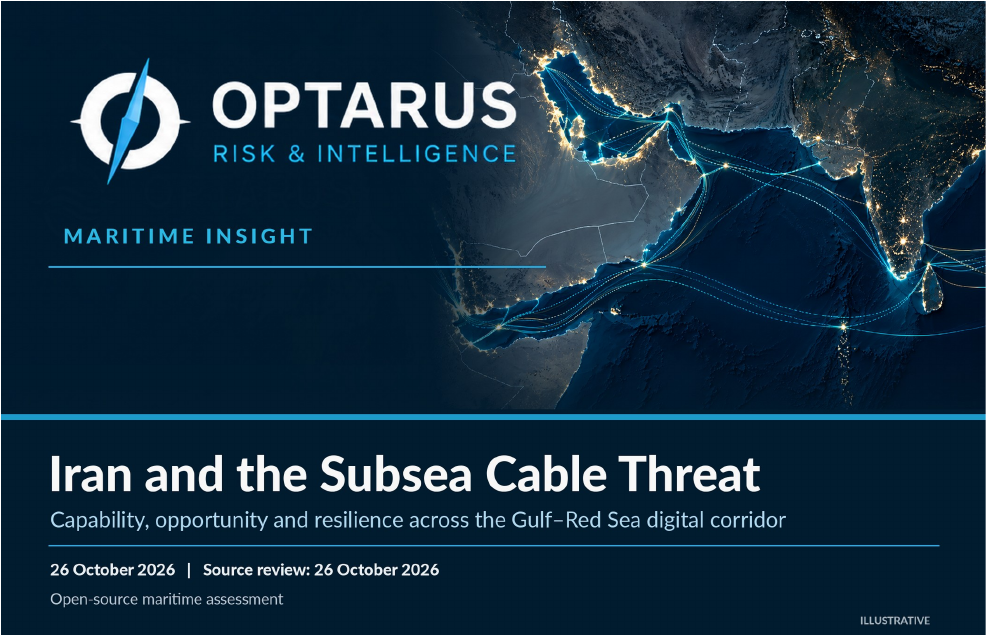
Iran’s warnings concerning undersea communications infrastructure in the Gulf raise questions about the vulnerability of international digital networks and the potential consequences of deliberate disruption.
In this Maritime Insight, Optarus examines Iran’s potential capability and opportunity to interfere with subsea communications cables, the practical challenges involved, and the consequences for regional connectivity, international commerce, cloud services and financial infrastructure.
The assessment also examines historical cable failures, alternative network routing, geographical exposure, repair timelines and the resilience of international communications systems.
Key assessment: Iran’s threats constitute a credible coercive signal, but a specialised capability to conduct coordinated attacks against subsea cables has not been independently established. Successful disruption could produce significant regional and commercial consequences; however, network redundancy means that damage to individual systems would not necessarily cause a global internet shutdown.
Intercontinental data traffic carried by subsea cables [5]<1%
International bandwidth traversing Hormuz [3]23.4 DAYS
2025 mean notification-to-departure [6]7.7 DAYS
2025 mean vessel transit [6]
Current threat profile
What changed, and how strong is the evidence?
Iranian officials have publicly threatened Gulf undersea communications infrastructure, while two unnamed Iranian security officials described contingency planning to Reuters. The first is an on-record coercive signal. The second is credible attributed reporting, but it does not provide corroborating operational evidence. No cable attack or present fault is asserted in this assessment. [1–3]
The International Cable Protection Committee identifies five active cable-system segments traversing Hormuz. Iranian references to seven cables should therefore not be treated as a validated inventory. Official maritime notices document a contested operating environment around Gulf shipping, but do not prove a cable-specific mission or specialised subsea capability. [9,10,14]
Means, opportunity and motive are separate tests
| Test | Supported assessment | Limit |
|---|---|---|
| Means | Iran has maritime strike and coercive capacity against shipping. | This does not establish the specialist ability to identify, reach and repeatedly damage buried or deep-water communications infrastructure. |
| Opportunity | Proximity to Gulf waters offers geographical access, while conflict could constrain survey and repair activity. | Surveillance, patrols, permissions and commercial precautions complicate access. Naval presence is not evidence of a cable mission. |
| Motive | A conditional threat could widen the perceived cost of renewed conflict for Gulf governments, investors and technology operators. | Execution would risk diplomatic, reputational and economic costs; signalling does not establish intent to act. |
Maritime operating picture
A physical cut is not equivalent to loss of the internet
Subsea fibre-optic cables are physical seabed infrastructure, but damage to one cable does not necessarily create an end-to-end service outage. Operators may reroute traffic across other subsea systems, terrestrial links and local or cached services. Rerouting can preserve reachability while raising latency, congestion and packet loss; it cannot create unlimited replacement capacity. [7,8]
Water depth, burial, armouring, seabed conditions, surveillance and access for repairs all affect feasibility. Global industry evidence shows that anchors and fishing activity account for most cable faults, not proven hostile action. Iranian statements that cables are readily accessible do not establish operational capability. [13,14]
Historical tests of resilience
The May 2024 East Africa cable failures and September 2025 Red Sea faults show that services can continue through alternative routes while suffering congestion and higher latency. They also show that logical service recovery may occur before the physical cable is repaired. These cases are evidence of adaptation, not a forecast or guaranteed recovery time for a contested Gulf incident. [7,8,15,16]
Geographical exposure
Regional consequence is more plausible than global shutdown
The location of damage matters more than the nationality of the actor. A Hormuz-specific incident would primarily affect Gulf-connected networks. A separate, larger Red Sea disruption could have greater potential to degrade Europe–Asia paths. These are distinct scenarios and should not be collapsed into a single assumed Iranian capability.
For Europe, the more credible exposure is selective latency, packet loss or application degradation affecting Gulf- and Asia-linked traffic, rather than general failure of domestic connectivity, online banking or cloud services. Wider effects would depend on individual providers’ route diversity, spare capacity, peering arrangements and dependence on particular regional hosts. [3,7,14–16]
Commercial exposure
Transmission disruption becomes a business-continuity problem
Gulf financial services and payments, trading systems, logistics platforms, ports, aviation, health services, government networks and data-centre operators could experience uneven effects. Some would remain available through redundant paths; others dependent on constrained international transit, particular cloud regions or remote authentication could degrade.
Secondary effects could include higher transit-procurement costs, increased demand for backup capacity, service-level disputes, repair-vessel insurance constraints and prolonged operational uncertainty. The exposure depends on each organisation’s actual dependency architecture, not an assumed region-wide blackout. [3,5,7,8,11,12]
Monitoring value
KASPR Pulse
KASPR Pulse measures district-level responding IPv4 connectivity, round-trip latency and jitter against historical baselines. It offers a potential independent indicator of geographically uneven degradation when readings are compared consistently over time. Its public data does not establish a current Iranian cable incident or attribute a fault to a submarine system. Operator notices, network-route measurements and repair advisories remain essential corroboration. [17]
Outlook and indicators
Coercive signalling without a seabed attack remains consistent with the conditional rhetoric. A limited physical fault followed by rapid logical rerouting is plausible where genuinely independent capacity exists. A correlated multi-fault event compounded by repair denial would be higher consequence, but depends on capability, intent and opportunity that have not been verified. A generalised global internet shutdown is not supported by Hormuz bandwidth data or network topology.
Decision-relevant indicators include independently verified cable-fault notices, simultaneous performance anomalies across unrelated carriers, corroborated interference affecting repair vessels, changes to repair permissions or war-risk cover, and sustained shortfalls in spare capacity. Attribution should remain open unless physical evidence, operator data and independent official assessments converge.
Bottom line
Treat the Iran cable threat as a credible coercive signal with uncertain specialised capability. The relevant exposure is not a guaranteed worldwide outage: it is the resilience of each organisation’s networks, the availability of genuinely independent paths, and the security and regulatory conditions under which any physical fault could be repaired.
Methodology and limitations
Open-source assessment using material reviewed on 26 October 2026. Evidence distinguishes on-record threats, anonymous claims, operational capability and scenario effects. The maps and schematics are generalised and do not represent exact cable routes, landing points or attack locations. Historical performance observations are not forecasts. No attack, sabotage attribution or present cable fault is asserted. KASPR is discussed as a measurement framework, not treated as verified incident data. AI assisted research and presentation; source evaluation and publication decisions remain Optarus editorial responsibilities.
This publication is strategic decision support. It is not legal, cyber-security, insurance, investment, navigational or security-operational advice.
Source appendix
Selected originating and specialist sources
- [1] Press TV / Al-Alam · 21 October 2026
Javani interview
Originating public statement; threat does not establish capability. - [2] IranWire · 20 October 2026
IRGC warning on undersea cables - [3] Reuters · 23 October 2026
Iran has detailed plans to hit Gulf undersea cables if war resumes, officials say
Attributed claims from two unnamed officials; no operational corroboration supplied. - [4] TeleGeography · 2026
Global Submarine Cable Map - [5] ITU / International Advisory Body · 10 July 2026
Global cable-resilience recommendations - [6] ICPC · 2026
2026 Plenary highlights and 2025 repair dataset - [7] Internet Society · 23 July 2024
2024 East Africa submarine-cable outage report - [8] Microsoft Azure · 6 September 2025
Archived Red Sea incident update - [9] US MARAD · 9 September 2026
Advisory 2026-011 - [10] UKMTO · October 2026
Recent incident warnings - [11] Ooredoo Oman · 17 August 2025
Salalah data-centre and cable-landing infrastructure - [12] European Commission · 5 February 2026
Submarine Cable Security Toolbox - [13] ICPC
Media enquiries and cable-fault facts - [14] ICPC · 20 May 2026
Strait of Hormuz media FAQs - [15] Cloudflare Radar · 2025
Q3 2025 Internet disruption summary - [16] Cisco ThousandEyes · September 2025
The Internet Report - [17] KASPR Pulse · accessed 26 October 2026
Regional Intelligence · Data documentation