
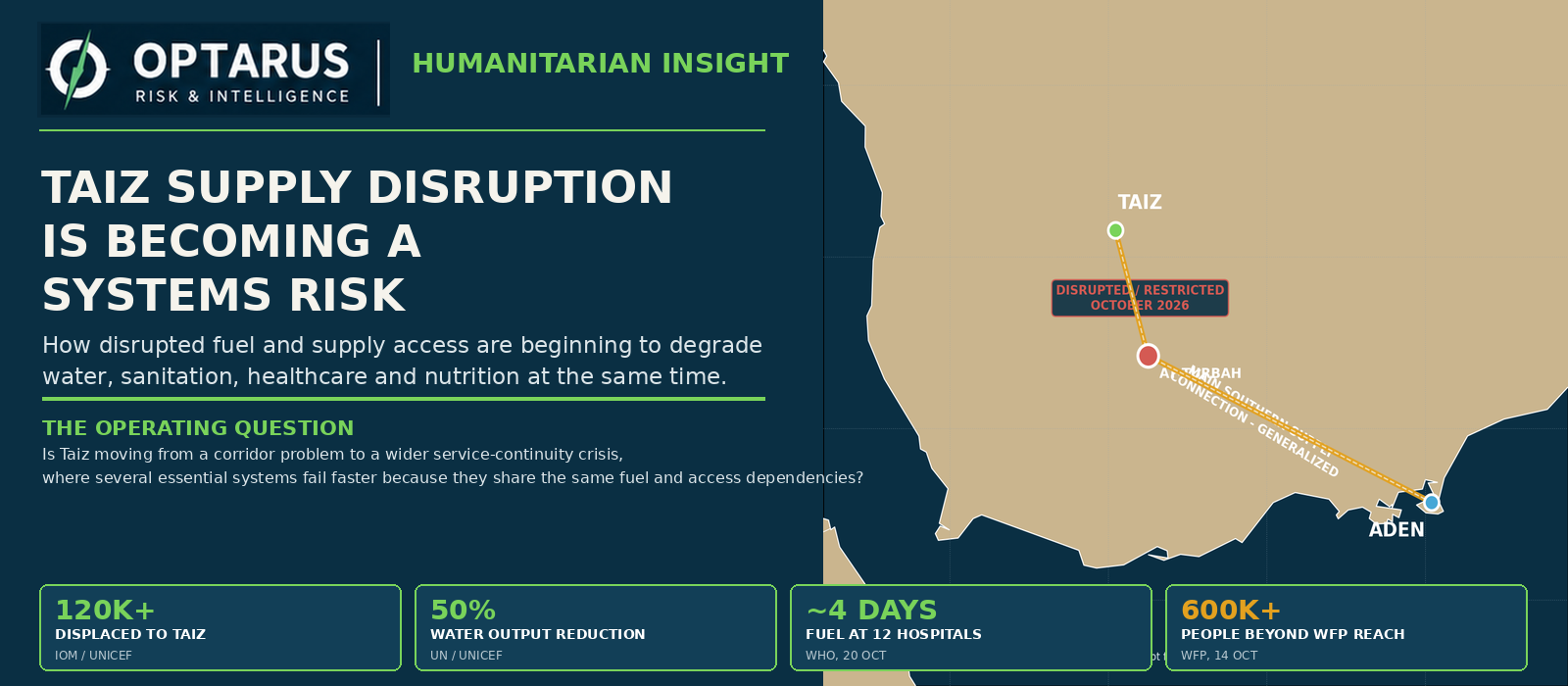
Taiz’s immediate problem is not simply whether a road is open or closed. It is whether fuel, food, medicines and humanitarian supplies can move into the city often enough, and reliably enough, to keep essential services working.
Key judgement. Taiz is no longer facing only a road-access problem. The current disruption is constraining a shared fuel-and-supply base used by water pumping, waste collection, hospitals, food markets and nutrition programmes. Unless dependable throughput recovers, several essential services could degrade together faster than any single-sector indicator would suggest.
One supply problem is beginning to appear across several services
UN reporting on 20 October described road closures and insecurity preventing fuel and other essential supplies from reaching Taiz reliably. UNICEF said fighting had disrupted the Taiz–Aden corridor. At the same time, water production has fallen sharply, hospitals are running down fuel and medicine stocks, waste collection is being disrupted and access constraints are limiting the distribution of therapeutic food.
Taken separately, these look like different sector problems. They are increasingly linked by the same two dependencies: fuel and reliable supply throughput.
Water provides the clearest example. The UN Humanitarian Coordinator reported that water production in Taiz had fallen by roughly half. UNICEF said diesel shortages were preventing pumping stations from operating continuously, while the price of trucked water had risen sharply. UNICEF is providing diesel to help keep major water systems operating.
This creates a second problem. When network pumping falls, households become more dependent on water trucking. But water trucking also needs fuel, vehicles, drivers and reliable road access. The fallback option therefore depends on the same resource that is already under pressure.
Waste collection shows a similar pattern. UNICEF reported that diesel shortages were affecting regular rubbish collection, while field reporting described growing waste accumulation and problems with normal disposal. This does not prove a new disease outbreak in Taiz, but poorer sanitation and reduced access to clean water increase public-health exposure at a time when communicable disease remains a wider concern in Yemen.
Health services are closer to an immediate continuity threshold. WHO reported that 12 hospitals had around four days of fuel remaining, that the city was facing a daily oxygen deficit, and that 115 of 127 essential medicines had roughly one week of stock or less. Emergency obstetric services had already been suspended in five districts.
Nutrition programmes show why stock availability is not the same as usable capacity. UNICEF had pre-positioned therapeutic food before the latest escalation, but said access constraints were preventing reliable distribution to the health facilities that need it. WFP separately warned that more than 600,000 people in Taiz who depend on humanitarian assistance had become inaccessible and that wheat-flour stocks in affected areas were close to exhaustion.
The emerging issue is therefore not a single shortage. It is the loss of reliable replenishment across several services at once.
The corridor is an accelerator, not the only cause
Taiz was already fragile before the latest disruption. Water scarcity, damaged infrastructure, weak municipal capacity, chronic underfunding, fragmented authority and difficult access all pre-date the current escalation.
That matters because it would be wrong to attribute every service failure to the Taiz–Aden corridor. Some local authorities are also reporting mitigation measures, including efforts to secure fuel for water systems, and a local medical organisation reported getting an emergency medicine shipment into Al-Thawra Hospital in mid-October.
The better judgement is that the current access disruption is acting as an accelerator. It is removing spare capacity from systems that already had very little resilience.
For humanitarian operators, access is becoming a throughput question
A road can be technically passable and still provide poor operational value.
If movements are irregular, if fuel cannot be replenished, if permissions change, or if commercial and humanitarian transport cannot move consistently, an “open” road may still be unable to support normal service delivery.
This is why competing claims about road openings should be treated carefully. Authorities on opposing sides have published different accounts of which routes are open and who is responsible for restrictions. Those claims matter, but the more useful test is practical: are fuel, food, medicines and humanitarian cargo moving through repeatedly and in enough volume to reverse the deterioration in services?
At present, that recovery is not yet evident in the service indicators.
For NGOs and UN agencies, this raises a different planning question. The issue is not simply whether a movement can still be made today. It is whether programmes have become dependent on a route, fuel source, transporter, hospital, water system or permission arrangement that is turning into a single point of failure.
Medical operators need to consider which services reach minimum operating thresholds first if fuel, oxygen or medicine stocks continue to fall. WASH programmes need to consider whether trucking can realistically compensate for lower network pumping when both depend on the same fuel base. Food and nutrition programmes need to identify whether the break is upstream stock, transport, authorisation or final access to facilities. Logistics providers need to distinguish one-off access from capacity that can support repeated movements.
What happens next
If dependable throughput remains constrained, the next stage is more likely to be prioritisation than the simultaneous collapse of every service.
Fuel and transport will increasingly be directed towards the most critical functions. Water-pumping schedules may become more intermittent. Routine waste collection may receive lower priority. Hospitals may protect emergency functions while suspending less immediately life-saving activity. Humanitarian programmes may have to choose which movements or deliveries can be sustained with the capacity available.
Over the next one to two weeks, the risk is that organisations become more dependent on smaller local stocks, emergency trucking and a narrower pool of suppliers and transporters. If stocks cannot be rebuilt and displacement demand remains high, cumulative degradation becomes more likely over the following weeks.
The important point is that these pressures can reinforce one another. Lower water production increases reliance on trucking. Trucking consumes more fuel. Fuel shortages also affect hospitals, waste collection and humanitarian vehicles. Reduced sanitation and health capacity then increase the consequences of already high levels of malnutrition and displacement.
What would weaken this assessment
The systems-risk judgement should be downgraded if reliable supply throughput is restored and the recovery is visible beyond the road itself.
The clearest evidence would be several consecutive days of verified commercial and humanitarian movements into Taiz, followed by improving fuel availability and prices, increased water-pumping output, regular waste collection, stabilised hospital fuel and medicine stocks, resumed therapeutic-food distribution and easing pressure in food markets.
If routes are described as open but those service indicators do not improve, the problem is likely to have moved beyond simple road access into local distribution, infrastructure, market or service-capacity constraints.
For organisations supporting Taiz, that distinction matters. The forward question is no longer only “Can we get through?” It is “Can the system replenish itself fast enough to keep essential services running?”
That is the point at which a supply disruption becomes a humanitarian systems risk.
Methodology and selected evidence
This assessment uses open-source reporting from the UN Humanitarian Coordinator for Yemen, UNICEF, WHO, the World Food Programme, IOM Displacement Tracking Matrix, ACAPS, Reuters, the Yemen Logistics Cluster, relevant Yemeni authority reporting and credible operational and local sources. Claims from conflict parties are attributed and are not treated as independently verified solely because they appear in official media.
The analysis distinguishes physical access from usable throughput and stock availability from last-mile delivery. Supporting reporting was checked for timing, provenance and whether an observed service problem could reasonably be linked to the stated logistics mechanism. The internal collection record contained watch-coverage gaps during the assessment period; the published judgement therefore does not claim exhaustive collection or complete observability.